Second-Hand Knowledge

ἓν οἶδα ὅτι οὐδὲν οἶδα

Socrates

I often ask myself in this day and age of dis/misinformation about what I truly know and I feel that I can confidently say that if I myself have not experienced a phenomenon first-hand, either as an observer of or as a direct participant of, then I do not truly have knowledge of that phenomenon, rather only a belief of it. And what are beliefs if not a level of certainty in the validity or invalidity of some statement or assertion? The advantage of knowledge is that it allows belief/certainty to be transferred to others without the recipient’s necessity to experience it themselves first-hand, often at a lesser cost than what the propagators of that knowledge paid to gain that knowledge. There is an implicit level of trust involved in this relationship, in that, the knowledge is assumed to have been tested against a reasonable level of scrutiny and that there is no motive in its declaration other than to propagate truth. Even with this trust, we can and should always attempt to retrace the steps the originator traversed to assert the validity of what is stated so that the information the is not merely accepted at face-value. Only then should we accept something as being true or false. I think that we too often accept someone’s credentials as being sufficient to justify what they purport to be true and never go beyond that and it is corrupting all that we know or believe we know. These days, I do my best to state “I do not know” or “I believe that…” rather than state that something is because in the end, all I have are beliefs, some just stronger than others.
Divided, we are falling

The more we are told we are special, the more we believe it to be true and the more we feed our ego, thus the more divided we become. There are people who long ago figured out that if we are divided, then we are in the dark, reaching out for the light switch. They discovered that if you tell those people that you have the light switch, many will believe you, real or not and you can charge them a fee and profit. I see throughout media constant ways in which we are told one group is special or another is special, and divisions are formed as a result. We are truly being manipulated and I believe this is intentional and is limiting us as a species from realizing our potential and purpose. There’s a very powerful idiom that captures this, “United we stand, divided we fall.” It is only through directed focus that we achieve great things, either on our own or as a collective.

One of the main tenets of Buddhism is that in order to find happiness, one must dissolve ego. I wholeheartedly agree with this idea. I see so much unhappiness everywhere and unfailingly I see it attached to ego in some way. Taking only what we need and leaving the rest for others, giving to charity, detaching ourselves from material, useless things that do absolutely nothing to better our souls – these are the things we should keep on the forefront of our minds. You will be told that you deserve more because you work harder or because things that were done to your ancestors by other peoples’ ancestors means you should get more or that how you feel is always normal and you should have the right to feel that way and others must respect it no matter what. This is all food for your ego and buying into it continues to divide us infinitesimally. Lift the veil, perceive what is happening, think your own thoughts, question, attempt to understand and always ask, “who is to profit from all of this?”

Why are drugs so popular?

As I look back at my days when I was a regular drinker and drug user, I feel the impetus was most often to seek detachment from my body. Either I was dealing with stress that I did not want to feel, or I was so used to self-medicating to escape the feeling of stress that I sought to feel that sense of detachment again because it felt so good. These days, I no longer drink, or smoke or consume anything other than caffeine (which I may one day give up as well). I do still get my highs, however, but I do so through meditation, contemplation, intense exercise and rest.

I often question why I and many others seek that detachment from body. Many of us prefer that state and would choose not to come back, if given the opportunity. I feel that all creatures tend to follow their nature and given that so many people choose to detach from physical reality, it makes me wonder, if we are trying to reattune to a more natural state than physical reality? Could it be evidence for immortal spiritual existence that we tend to seek out a state more akin to our true endemic state, namely, one of disembodied consciousness?

Admittedly, I got pretty close on many occasions, since I’d wake and use any chance I could get and I’m sure you know the rest of the story. I had many health, social and familial problems. I missed out on countless opportunities for unique and once-in-a-lifetime experiences because I chose to drink/smoke instead. Those are some of the regrets I’ll carry with me as heavy baggage into my judgement or possibly my next lifetime, so I’m intent on really internalizing those mistakes in this incarnation such that if I were to be reincarnated (perhaps, yet again) then I hope to not make those same mistakes. And if I am to be judged, then I can only hope that I have properly atoned for the hurt I’ve caused.

I try to do a lot of soul searching and really drill into why I make certain choices and what I truly believe at year 43 of this lifetime. I have fought many battles, as I’m certain most others have and ultimately, I wish for internal peace. We are all warriors, so to speak, fighting the conditions life throws at us, or that we create ourselves, most often unknowingly. At some point in every warrior’s life, peace becomes the goal and I no longer believe it comes from outside sources.

Greek Accents

NameAccent
Acuteά
Circumflex
Grave

Greek words have as many syllables as they have vowels/dipthongs:

WordSyllablesBreakdown
λόγος2λό-γος
ἄνθρωπος3ἄν-θρω-πος
δοῦλος2δοῦ-λος
ἀλήθεια4ἀ-λή-θει-α

A syllable is long, if it has a long vowel or dipthong

VowelLengthExampleSound
αshort/long father(long)/bat(short)
εshortμέν
ηlongἡμέρα
ιshort/longmachine(long)/pit(short)
οshort
ωlong
ουlong
-οιlongλόγοι
οι-shortλόγοις
-αιshortἡμέραι
αι-longἡμέραις

Accent Rules

acute – ά

AntepenultPenultUltimaCondition
short/longif ultima is short
shortalways
longif ultima is long
short/longalways
  • can stand on short antepenult, if ultima is short
  • can stand on long antepenult, if ultima is short
  • can stand on short penult
  • can stand on long penult, if ultima is long
  • can stand on short ultima
  • can stand on long ultima

circumflex – ᾶ

AntepenultPenultUltimaCondition
longif ultima is short
longalways
  • can stand on long penult, if ultima is short
  • can stand on long ultima

grave – ὰ

AntepenultPenultUltimaCondition
short/longalways
  • can stand on short ultima
  • can stand on long ultima
  • formed from acute, if word following accented word is not enclitic

General Rules

  • Nouns
    • Accent tries to stay on same location as is found on nominative singular, as rules above permit.
    • Accent location of nominative singular is specific to each noun and must be learned.
  • Verbs
    • Accent is recessive. It tries to stay as far away from the ultima as rules above permit.

Proclitics/Enclitics

Proclitics

A proclitic leans on the word following it, forming a single unit of accent. They have no accent of their own.

Include:

  • Definite Articles – ὁ,ἡ,οἱ,αἱ
  • Negative – οὐ
  • Prepositions – εἰς,ἐκ,ἐν
  • Particles – εἰ,ὡς

Enclitics

An enclitic leans on the word preceding it, forming a single unit of accent.

Include:

  • Present indicative forms of εἰμί, excluding εἶ
  • Indefinite pronoun forms of τις and τι
  • Unstressed forms of 1st and 2nd personal pronouns: μου,μοι,με,σου,σοι,σε

Rules:

  • If a word preceding an enclitic has an acute on the ultima, it doesn’t change to a grave.
  • If a word preceding an enclitic has an acute on the antepenult or a circumflex on the penult, it acquires a second accent (acute) on the ultima.
  • If a word preceding an enclitic is proclitic/enclitic, it acquires an acute on the ultima.
  • If a word preceding an enclitic has an acute on the penult and the enclitic has two syllables, it retains its accent.
  • If an enclitic begins a sentence/clause, it retains its accent.

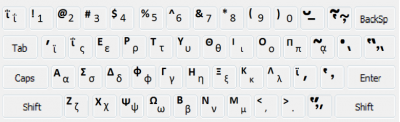
Polytonic Keyboard

Punctuation


The period and comma are the same as the English keyboard.

DescriptionCharacterKey Combination
Raised Dot.Alt + Shift + ]
Question Mark;Q, Space

Accents and Breathing Marks


In order to insert a vowel with any type of accent or breathing mark, you must first input the key sequence for the desired accent followed by the desired vowel. For example, ά is input by
pressing the ; key and then pressing the A key.

Accent KeyExampleKey Combination
Acuteά;
Grave]
Circumflex[

The easiest way to remember breathing marks is that the English Keyboard key used for each
type resembles the accompanying accent.

Breathing MarkExampleKey Combination
Smooth
Smooth + Acute/
Smooth + Grave\
Smooth + Circumflex=

To insert a rough breathing mark use Shift+ the above listed key for the desired breathing mark. For example, a rough breathing mark + grave accent (ἃ) is inserted by Shift + \ followed by the desired vowel.

Breathing MarkExampleKey Combination
RoughShift + ‘
Rough + AcuteShift + /
Rough + GraveShift + \
Rough + CircumflexShift + =

Iota Subscript

  • The iota subscript (ᾳ) when it is not combined with an accent or breathing mark is inserted by pressing Shift + [ followed by the desired vowel.
  • The iota subscript may also be combined with any of the above vowels and breathing marks by holding Right-Alt + the above listed key for the desired accent or breathing mark. This includes holding Shift for rough breathing marks. For example, a rough breathing mark + grave accent with an iota subscript (ᾃ) is inserted by pressing Right Alt + Shift + \ followed by the desired vowel.

On Existential Perspectives

I see at least three perspectives regarding the possibility of existential meaning:

  • The perspective that there is no meaning to anything that we do, other than that which we attach ourselves. Everything has a rational and scientific explanation and any meaning we perceive from the occurrence of events is purely psychological in origin.
  • The perspective that each of our decisions and actions have meaning relative to a grander scheme of which we have varying degrees of comprehension. To harbor such a perspective would be predicated by the belief that our decisions and actions are logged and that we are part of a system.
  • The perspective that it doesn’t matter either way. The belief that we should just enjoy ourselves and live life however we see fit is the cornerstone of this perspective. This makes no comment on whether a good or bad life is lived nor whether there is a greater system of which we are a part of. The argument can be made that sole intention of living is to soak up as many experiences as we can.